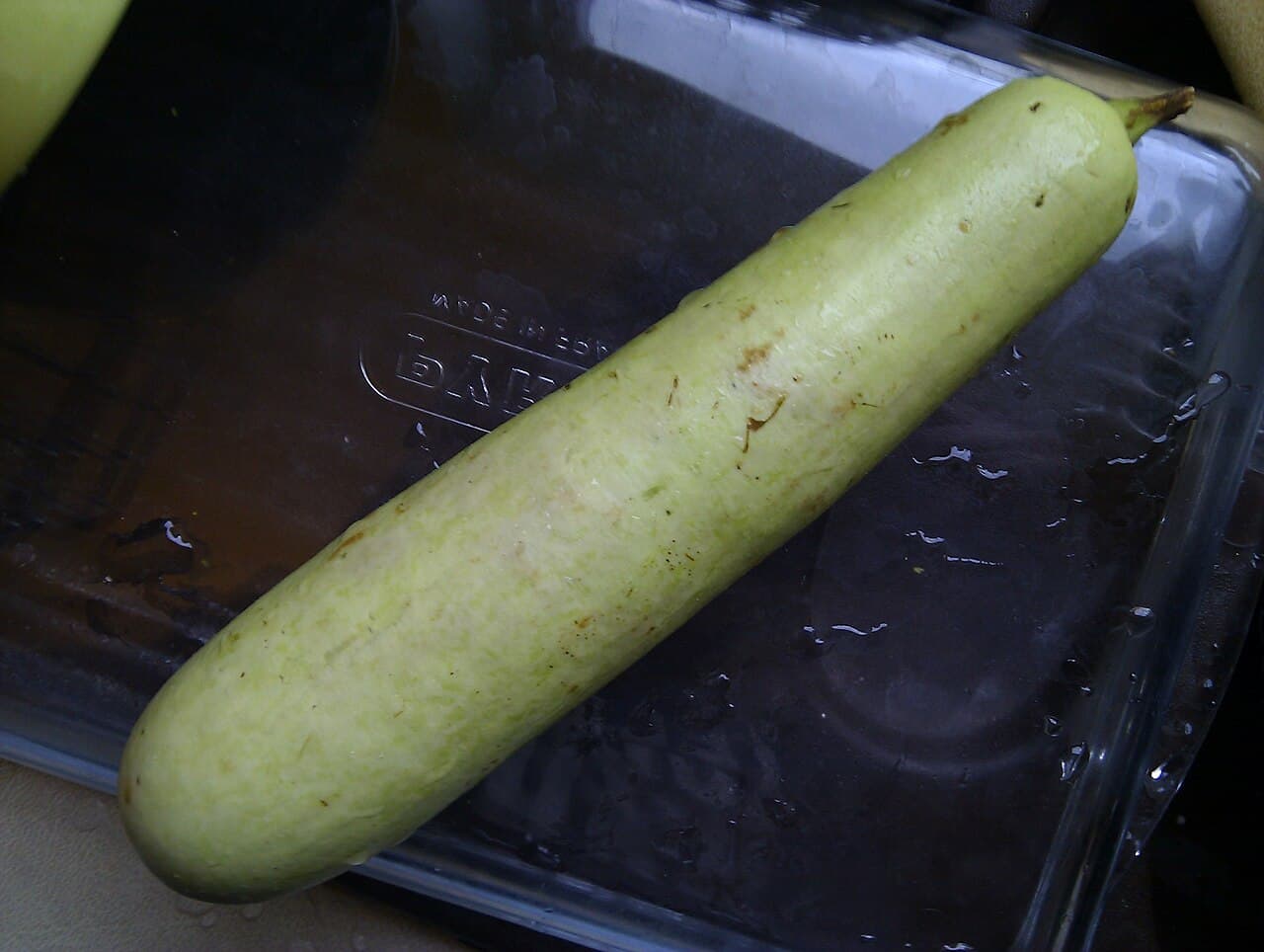
Bottle gourd
Also called: دباء · قرع · Lauki · Dudhi
One of the few gourds that copes with warmth, so it is sown in February and March and picked into June, with a second sowing possible in late August. It is eaten young and tender in cooking, and needs a strong trellis. This window is less certain than most, so check it.
The year at a glance
Each month is split in half. The outline marks now.
Stage by stage
Stage 1 of 9
Seed
Days 0–4
Seed
Days 0–4The seed sits in the soil taking up water and swelling. Nothing shows above the surface — everything is happening underground.
Do now
- Water lightly and often so the soil stays damp but never soaked. Letting it dry out between waterings kills the seed before it sprouts.
- Cover the surface with a thin layer of straw or compost to slow evaporation and steady the temperature.
- Label what you sowed and when. You will need the date to work out the harvest.
Watch for
- A hard crust forming on sandy soil after watering, which traps the sprout underneath. Break it gently.
- Ants carrying small seeds away — a very common problem in Qatari gardens.
In Qatar
Soak the seed overnight and sow 3 cm deep. The seed is hard and slow in cold soil, so wait until February.
Germination
Days 5–10The seed coat splits: a root pushes down and a shoot pushes up. The two seed leaves that appear are not true leaves — they are the seed’s own food store.
Do now
- Keep moisture constant. The first root is very fine and a single dry day can end the seedling.
- Remove any covering as soon as the first sprout shows, or it will stretch thin looking for light.
- Give bright, indirect light. Direct midday sun will scorch a new seedling within hours.
Watch for
- A long, thin, pale stem: the seedling is not getting enough light and will collapse.
- Sudden wilting with a pinched stem at soil level — damping off, caused by overwatering.
In Qatar
Up in a week in March warmth. Keep the soil damp without soaking it.
Seedling
Days 11–22The first true leaves appear, shaped differently from the seed leaves. The plant is now feeding itself and the roots are branching fast.
Do now
- Thin crowded seedlings and keep the strongest. Crowding gives you many weak plants instead of one good one.
- Start watering less often but more deeply, to drive the roots downwards.
- Harden the seedling off — build up its sun exposure over a week before transplanting.
Watch for
- Yellowing lower leaves: nitrogen shortage, very common in Qatar’s poor sandy soil.
- Small holes or chewed edges, meaning snails or young grasshoppers.
In Qatar
Never transplant it; gourd roots hate disturbance. Put the trellis up before the tendrils start searching.
Vegetative growth
Days 23–39The trailing stems run fast and tendrils appear. The plant is hunting for something to climb, and training it now decides the shape of the whole crop.
Do now
- Put the trellis up now and train the stems onto it. Getting the vine off the ground cuts disease and pests dramatically.
- Tie the stems with soft, wide strips of cloth rather than thin twine that cuts in.
- Water deeply in the early morning. Evening watering plus high humidity invites fungal disease.
- Check the undersides of leaves weekly for whitefly and aphids.
Watch for
- Stems trailing on hot ground and scorching underneath.
- Lush leaves but no flowers: too much nitrogen. Stop the nitrogen feed.
In Qatar
Train it up a strong overhead trellis or a fence. Fruit hanging in the air stays straight, clean and away from soil rot.
Flowering
Days 40–52Male flowers open first, then female ones with a miniature fruit already behind them. Only the female flowers bear, and pollen has to reach them.
Do now
- If nothing is setting, hand-pollinate: pick a male flower and dab it into the centre of a female one in the morning.
- Cut back nitrogen and raise potassium and phosphorus to support fruit set.
- Never let the soil dry out completely between waterings. Drought now makes the flowers drop.
Watch for
- Flowers dropping without setting fruit: above about 35 °C the pollen goes sterile. Get shade over it now.
- No pollinating insects at all — common on enclosed roofs and balconies.
In Qatar
The white flowers open in the evening. In an enclosed garden, hand-pollinate at dusk, not in the morning as for cucumber.
Fruit set
Days 53–60The petals wither and the ovary behind them swells. Small, hard green fruits appear and grow day by day.
Do now
- Make watering perfectly regular. Swinging between dry and drenched causes most fruit cracking and rot.
- Support the fruiting branches before the weight breaks them.
- Add calcium if your irrigation water is brackish, to head off blossom-end rot.
Watch for
- A sunken brown patch at the base of the fruit: calcium shortage from irregular watering or salinity.
- Small fruits yellowing and dropping: the plant is carrying more than it can feed, or it is thirsty.
In Qatar
Bag young fruit in paper against fruit fly. The fruit grows startlingly fast in April warmth.
Ripening
Days 61–64The fruit stops growing and starts changing colour, turning its starch into sugar. Heat speeds this stage up.
Do now
- Ease off the water slightly to concentrate the flavour — but never to the point of wilting.
- Shade exposed fruit with the plant’s own leaves to prevent sunscald.
- Pick as things ripen. Leaving fruit on the plant stops it setting new ones.
Watch for
- White or leathery brown patches on the sun-facing side: sunscald.
- A small hole with rot inside, meaning fruit worm.
In Qatar
There is no real ripening: bottle gourd is eaten unripe. Pick it at 30–40 cm while the skin is still soft.
Harvest
Days 65–120The fruit is ready. The plant is at peak production and will keep bearing as long as you keep picking and the weather holds.
Do now
- Pick in the early morning when the fruit is full of water and will keep longest.
- Use scissors rather than pulling by hand, so you do not tear the branch.
- Keep feeding potassium every two weeks to stretch the picking season out.
Watch for
- New fruit coming smaller: the plant is exhausted and needs feeding.
- The seasonal heat rising, which will shut production down within weeks.
In Qatar
Pick every three or four days from April to June. One forgotten gourd turns woody and stops the vine producing.
End of cycle
Days 121–150Production tails off and the leaves yellow. As the heat builds the plant stops setting fruit altogether.
Do now
- Bring in the last of the fruit, even the ones not fully ripe.
- Save seed from the best fruit on the strongest plant if you want to grow it again.
- Pull the plant and compost the healthy remains; bin or burn anything diseased.
- Work compost into the soil now, ready for the next Al-Wasm.
Watch for
- Leaving diseased plants in the ground carries pests over to next season’s crop.
- Bare soil under the sun goes dead. Cover it or sow a green manure.
In Qatar
It collapses in July’s peak heat. If you want seed, leave one gourd to ripen and dry on the vine.
- Water
- High
- Salt tolerance
- Medium
- Heat tolerance
- High
14 L/week in winter, 38 L in summer
Soil preparation
Greedy for water and food. Dig a 40 × 40 cm hole and fill it with a half-compost mix. The roots are shallow and wide, so mulch the soil thickly.
Pests
Cucurbit fruit fly
- Sign
- Small punctures in young fruit, internal rot and the fruit dropping.
- What to do
- Bag young fruit in paper as soon as it is finger-sized, and hang pheromone traps.
Powdery mildew
- Sign
- A white coating on the leaves appearing with April warmth.
- What to do
- Spray a milk solution weekly from March as prevention, not cure, and lift the vines onto a trellis.
Common problems
Flowers but no fruit
- Cause
- Gourd flowers open in the evening and are pollinated by night insects, which are absent in walled gardens.
- Fix
- Hand-pollinate at dusk with a male flower — not in the morning, as you would for cucumber.
Hard-shelled, bitter fruit
- Cause
- Leaving the fruit to grow on. The skin turns woody within days.
- Fix
- Pick every three or four days at 30–40 cm, while a thumbnail still marks the skin.
Picking
Pick young, while a thumbnail still marks the skin and it is 30–40 cm long. A big hard gourd is inedible and stops the vine producing.
Keeping
Five days in the fridge. Peel and cook it or stuff it. It does not freeze well fresh.